
The future of Physical AI for mobility will be transformative: modular vehicles that can autonomously reconfigure themselves. Anywhere.
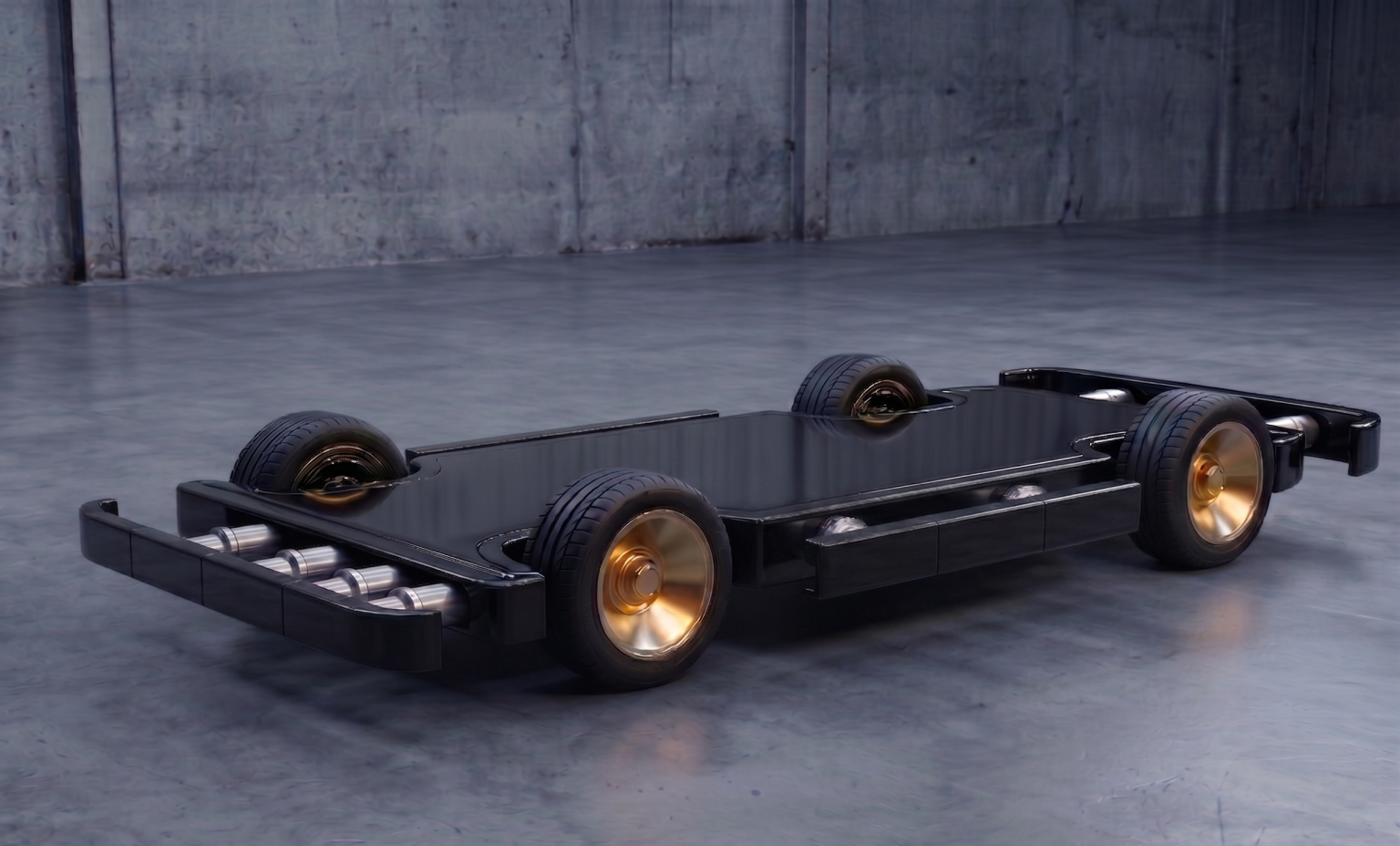
At AV Exit, we’re not building vehicles. We invented the transformation behavior IP. Swap by AI™ defines a new approach to modular vehicles for the autonomous age, conceptually based upon a longer-life Power Platform (chassis, battery, motors, and wheels engineered for 20+ years of service, plus AI compute and cameras to drive autonomously when the pod is detached) and a separable Passenger Pod (the customizable cabin, likely refreshed every 3 to 4 years to keep pace with advancing AV compute and evolving consumer needs).
The Swap by AI™ Family
Swap by AI™ • Enter by AI™ • Safe by AI™ • Charge by AI™ • Exit by AI™
Each behavior is described in The Swap by AI™ Advantage section below. Patent status detail in the Patent Portfolio summary.
Swap by AI™ in NVIDIA’s ecosystem: AlpaSim can test it. Cosmos-Dreams can render it. AlpaGym can train it. Alpamayo can reason about it. Halos can evaluate it. DRIVE AGX Thor can embody it. DGX can refine it through fleet data once vehicles are on the road. The future is now.
Physical AI is artificial intelligence that doesn’t just describe the physical world but acts on it: perceiving conditions, reasoning about response options, and executing physical change. NVIDIA’s broader stack (Omniverse and Cosmos for simulation, DRIVE AGX Thor for embodiment, DGX for refinement) has made the compute foundation possible, and the Alpamayo Open Platform (the Alpamayo models, the AlpaSim simulation framework, the AlpaGym training framework, and the Physical AI Dataset), with the Cosmos-Dreams world model, now turns that compute into AV-specific tooling. As Jensen Huang put it at GTC Berlin in October 2026, simulation is “where we have the AI learn how to do its skills,” inside a digital twin, before it acts in the physical world. The skills vehicles will perform with that compute remain to be defined.
AV Exit’s IP defines transformation behavior: skills no vehicle’s AI has learned yet, because no vehicle has performed them yet. Not as software running on top of NVIDIA’s stack, but as patented and patent-pending architectural definitions of what a self-reconfiguring vehicle can do.
FIVE SCENES FOR FIVE BEHAVIORS
Picture an autonomous vehicle pulling into a driveway, detaching its cabin onto temporary supports, accepting a different cabin configuration, and driving away. Without human intervention. No depot, no fixtures. On a flat surface that didn’t need to be prepared for the operation. That’s Swap by AI™.
Picture a vehicle whose passenger doors open and close not via dedicated motors but via the same wheels that drive it down the road, eliminating an entire mechanical subsystem and its lifetime failure modes. That’s Enter by AI™.
Picture a vehicle that perceives an imminent, unavoidable impact and, before contact, extends AI-controlled bumpers, moves its cabin back on the chassis, and meters the crash energy segment by segment, partially separating the cabin if needed to keep the force away from its occupants. That’s Safe by AI™.
Picture a parked vehicle with a solar-energy collecting photovoltaic roof, whose cabin detaches and tilts onto support legs, revealing additional photovoltaic surface on the platform itself, while the cabin remains usable for working, sleeping, or storage. That’s Charge by AI™.
Picture a vehicle whose AI sees an oncoming car it cannot avoid and, with seconds to spare, sends the entire passenger pod rearward off the chassis, leaving the empty platform to take the impact. That’s Exit by AI™.
WHERE THESE SKILLS ARE LEARNED
NVIDIA’s Alpamayo, the autonomous-vehicle reasoning model announced by Jensen Huang at CES 2026 in January, is the first NVIDIA full-stack AV deployment to reach a production vehicle: the all-new Mercedes-Benz CLA, debuting NVIDIA’s full-stack driving software (then called DRIVE AV, now marketed as the Alpamayo Stack) with a U.S. Level 2++ launch in 2026. At GTC Berlin in October, Mercedes-Benz announced it is extending the partnership to Level 3 and Level 4 development.
At GTC 2026 Taipei in June, the model family advanced to Alpamayo 2 Super (an open 34-billion-parameter reasoning model with full 360-degree perception, available on Hugging Face). At GTC Berlin in October, NVIDIA added Alpamayo 2 Edge, a compact reasoning model that runs on the vehicle’s own DRIVE AGX Thor, and automakers including Volvo Cars and Mercedes-Benz adopted the Alpamayo Stack, NVIDIA’s full-stack driving software on DRIVE Hyperion. Alpamayo demonstrates that AVs can be trained to reason from a few million simulation miles rather than billions of real-world miles.
NVIDIA’s AlpaSim, the open-source closed-loop simulation framework released at CES 2026 and available on GitHub, orchestrates the environments in which Alpamayo’s policy decisions get tested in real time.
NVIDIA’s Cosmos-Dreams, real-time generative closed-loop AV simulation built on Cosmos, generates the photorealistic, action-conditioned views inside the simulation loop. Text-prompt scenario authoring lets developers describe what should happen and then watch the simulated “ego” AV respond.
NVIDIA’s AlpaGym, the closed-loop reinforcement-learning framework introduced at GTC 2026 Taipei in June, post-trains the policy through continuous decision-and-observation cycles inside AlpaSim.
NVIDIA’s Physical AI Dataset, another component of the Alpamayo open platform, supplies the real-world driving data Alpamayo learns from: 300,000 clips spanning 1,700 hours across 2,500 cities in 25 countries. The Dataset captures what fleets do today (lane following, merging, braking, urban navigation). Transformation behaviors lie beyond what any fleet performs yet.
NVIDIA Halos, NVIDIA’s full-stack safety system for autonomous vehicles, gained a new framework at GTC Berlin, now part of the Alpamayo Stack: Halos SAFE (Safety Assurance Framework for Evaluation), which links simulation, hardware-in-the-loop testing, on-road testing, and fleet monitoring to turn defined scenarios, tests, and measurable performance criteria into traceable safety evidence, with evaluation partners including dSPACE, IVEX, and TÜV Rheinland. Safe by AI™ and Exit by AI™ are defined in exactly those terms: specific crash conditions, specific responses, measurable outcomes.
AV Exit’s IP is the missing content for this open platform. These behaviors cannot be learned from observation, but they can be defined architecturally by AV Exit’s IP, run as closed-loop scenarios in AlpaSim, rendered photo-realistically by Cosmos-Dreams, post-trained through AlpaGym, evaluated under Halos, and used to train Alpamayo’s reasoning. Once Alpamayo learns the behaviors, DRIVE AGX Thor onboard compute executes them on modular vehicle hardware in the real world.
WHY NOW
The EV transition has been disrupted by policy shifts, tariff regimes, charging infrastructure gaps, raw materials volatility, demand shortfalls, and write-downs across multiple legacy automakers. The industry pattern is now visible: incremental EV strategies face structural headwinds that no single OEM can solve on its own timeline. The strategic question for an OEM facing that pattern is not how to fix EV-1.0. It’s how to leapfrog past it into AV Level 4 (hands-off, eyes off), and beyond.
Physical AI is the leapfrog. It is built to move. Modular autonomous vehicles built on NVIDIA’s compute stack and AV Exit’s transformation behavior IP represent a new paradigm, self-reconfigurable modularity: vehicles whose architectural moves create capabilities no unibody vehicle can mechanically perform. An OEM committing to this approach isn’t catching up on EVs. It’s defining the next category while competitors are still solving the last one. NVIDIA supplies the platform. AV Exit supplies the paradigm.
FROM PARADIGM TO PRODUCTION
NVIDIA’s DRIVE Hyperion has become the common platform for the autonomous age. At GTC Taipei in June 2026, Jensen Huang said car manufacturers representing roughly 80% of the world’s vehicles have adopted DRIVE Hyperion, NVIDIA’s Level 4-ready platform. These are the OEMs that would build modular AVs, and the manufacturing base that would build Swap by AI vehicles. BYD, Geely, Nissan, and Hyundai (four of the world’s top ten automakers) adopted DRIVE Hyperion for Level 4 development in March. In October, Volvo Cars expanded its NVIDIA partnership, and at GTC Berlin NVIDIA announced that Volkswagen, JLR, Volvo, and Mercedes-Benz vehicles will join its Hyperion robotaxi network, with Bolt planning at least 25,000 Level 4-capable Lucid vehicles in Europe. As Jensen Huang said in Berlin, “every single car company will want to make their cars part of the ride hailing fleet.” A ride-hailing fleet is where a swappable pod earns its keep: one platform, a passenger pod by day and a cargo pod by night.
The NVIDIA-Hyundai partnership announced in October 2025 anchors South Korea’s National Physical AI Cluster, a public-private partnership deploying roughly $3 billion and 50,000 NVIDIA Blackwell GPUs. The partnership encompasses Kia, whose Platform Beyond Vehicle line builds passenger, cargo, and chassis-cab versions on one platform, with each body fixed at the factory or by a conversion partner. Kia’s Easy Swap concept would exchange rear modules at a purpose-built facility. Swap by AI™ enables autonomous pod exchange anywhere, no depot required. Enhanced consumer convenience. Reduced OEM infrastructure cost.
These concept renderings illustrate our patented and patent-pending technologies. The Swap by AI™ family of transformation behaviors can be integrated with most modular designs.




VERSATILITY
A single Power Platform serves fundamentally different use cases across its life: passenger, cargo, work, family, recreation. Each via a different pod. Swap by AI™ enables autonomous pod exchange anywhere a flat surface exists. No dedicated swapping station required. As Swap by AI™ inventor Dave Carroll puts it: “mobile office for the week, pickup pod for the weekend.” Or as our slogan puts it: One platform, many lives.
SAFETY
Modular AVs gain crash-response options that unibody vehicles mechanically cannot perform. Safe by AI™ meets an unavoidable impact with AI-controlled bumpers that extend before contact and meter the crash energy segment by segment, moves the cabin rearward for a longer, gentler ride-down, and can partially separate the cabin to keep force away from its occupants. Exit by AI™ sends the pod clear of an oncoming vehicle when there is warning and room behind; for a stationary obstacle, the vehicle brakes and absorbs instead. The AI selects among these responses, alone or in combination, as the situation develops rather than in a fixed sequence. All are deliberate vehicle-initiated responses, extending the vehicle’s toolkit beyond what crumple zones and steering avoidance alone can offer.
VALUE
A Power Platform engineered for 20+ years amortizes the costliest components across multiple cabin generations. This may allow for longer-term platform financing and thus lower monthly payments for the vehicle overall. OEMs earn recurring revenue from pod refresh cycles every 3 to 4 years rather than from a one-time vehicle sale. Consumers keep the platform for decades and refresh the cabin to keep pace with advancing AV compute. NVIDIA’s silicon presence scales accordingly: Thor count per vehicle increases from 2 (unibody) to up to 4 (Power Platform plus Pod), with additional Thors arriving as pods refresh across the platform’s lifecycle. Enter by AI™ uses the platform’s own wheels to actuate pod doors, removing dedicated door motors and the associated parts count.
SUSTAINABILITY
Charge by AI™ reveals the Power Platform’s photovoltaic surface when the pod separates, with AI coordinating timing, positioning, suspension tilt, and energy transfer. By exposing surface area normally covered when assembled, this transformation behavior effectively multiplies the vehicle’s solar collection capacity. The architecture reduces lifetime resource consumption: one durable platform serves multiple cabin generations rather than each generation requiring a complete new vehicle.
PATENT PORTFOLIO
Five branded behaviors anchor a portfolio of three issued U.S. patents, a patent allowed in China, and eight pending applications in the United States, Europe, and South Korea.
Swap by AI™ — U.S. Patent 12,515,705 (issued January 2026)
Exit by AI™ — U.S. Patent 11,618,474 (issued April 2023); continuation and implementation applications pending
Swap by AI™ and Exit by AI™ abroad — one international application family claims both core behaviors: allowed in China (September 2026; issue fee paid), with claims covering emergency pod separation and interchangeable pods and platforms; pending in Europe and South Korea, with claims to both behaviors
Enter by AI™ — U.S. Patent 12,637,028 (issued May 26, 2026)
Safe by AI™ — Provisional patent applications filed April and October 2026
Charge by AI™ — Provisional patent application filed April 2026
A consolidated application filed August 2026 describes all five behaviors on common hardware.
Founded in 2022 in Grantsburg, Wisconsin, AV Exit, LLC owns the Swap by AI™ family of patented and patent-pending transformation behaviors.
DAVE CARROLL, FOUNDER/CEO
Co-founded RAM Center (FANUC’s multi-year top distributor) in 1986. Forty years of patented invention across industrial and retail robotics, wearable computing, LED lighting, and advanced manufacturing education. Sole inventor of the Swap by AI™ family.
IAN D. CARROLL, PRESIDENT
Leads strategy, partnerships, and acquisition positioning. Background in research and strategy for crisis communications. Engaging NVIDIA, OEM ecosystem partners, and strategic investors for acquisition and partnership discussions.
Swap by AI™, Enter by AI™, Safe by AI™, Charge by AI™, and Exit by AI™ are trademarks of AV Exit, LLC. Protected by U.S. Patents 12,515,705, 11,618,474, and 12,637,028, with additional U.S. applications pending, a patent allowed in China, and applications pending in Europe and South Korea.
© 2026 AV Exit, LLC. All Rights Reserved.